Why Working Out With Others Actually Works: The Science Behind Gym Communities
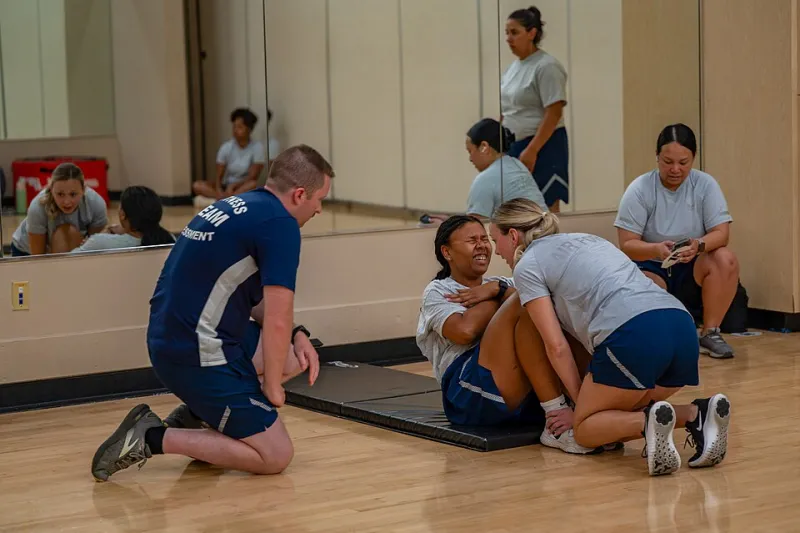
Photo: U.S. Air Force photo by Zelideth Rodriguez, Public domain, via Wikimedia Commons
Ask most people why they stopped going to the gym and they'll tell you some version of the same story. Life got busy. Motivation dried up. It stopped feeling worth it. What they usually don't say — because they might not even realize it — is that they stopped going right around the time they stopped having a reason to be there beyond the workout itself.
That gap between intention and follow-through is one of the most studied problems in behavioral health. And the research keeps pointing toward the same answer: social connection isn't a bonus feature of a good fitness environment. It's a core ingredient.
The Dropout Problem Is Bigger Than You Think
American gym culture has a retention crisis. Industry data consistently shows that a significant portion of new gym members — estimates range from 50 to 67 percent — stop attending within the first six months of joining. January sign-ups flood in, February attendance peaks, and by spring, the equipment is freed up again.
Willpower is usually blamed. But researchers who study exercise behavior have largely moved past that explanation. A 2017 study published in the journal Obesity found that participants who worked out alongside a partner — especially one who was slightly more fit than themselves — exercised significantly longer and at higher intensities than those who trained alone. The mechanism wasn't competition. It was what the researchers called the Köhler effect: people simply don't want to be the one who quits first when someone else is counting on them.
That effect scales. When the "partner" becomes a community, the accountability multiplies.
Third Places and Why They Matter Now
Urban sociologist Ray Oldenburg coined the term "third place" back in the 1980s to describe the social environments beyond home (first place) and work (second place) where people gather informally, build relationships, and feel a sense of belonging. He was talking about barbershops, diners, and neighborhood bars. But the concept has taken on new urgency in the 2020s.
The pandemic didn't just disrupt fitness routines — it dismantled a lot of the casual social infrastructure that people had taken for granted. Remote work eliminated workplace relationships. Local gathering spots closed. The kind of low-stakes, repeated social contact that builds community quietly disappeared for a lot of Americans.
Gyms that leaned into their role as community spaces during and after that period didn't just retain members — they grew them. Facilities that hosted outdoor workouts during lockdowns, maintained active online member communities, and rebuilt with intentional social programming came back stronger. Members who had found their people there weren't just returning for the equipment. They were returning for the place itself.
What the Research Says About Community and Consistency
The data on socially embedded fitness environments is fairly striking. A study out of the University of Aberdeen found that finding a new exercise partner led to a significant increase in workout frequency — more so than motivational strategies that focused on individual goal-setting alone. The social element wasn't a supplement to motivation; in many cases, it replaced the need for it.
Research from Michigan State University reinforced this, showing that exercising with a virtual partner (even someone the participant had never met in person) improved performance and persistence compared to solo training. The mere awareness that someone else was engaged in the same activity created a sense of shared effort that translated into better outcomes.
On the mental health side, the evidence is equally compelling. Group exercise has been associated with lower perceived stress and higher quality-of-life scores compared to solo training, according to a 2017 study published in the Journal of the American Osteopathic Association. The physical benefits of working out are well-documented. The psychological benefits of working out with people appear to be additive — and in some cases, more significant than the exercise itself.
Real Members, Real Results
The numbers land differently when you hear them reflected in actual experience. Members at community-focused gyms consistently describe a shift in how they relate to their own fitness goals once they become embedded in a social environment.
The pattern tends to follow a recognizable arc: someone joins a gym with a specific outcome in mind — lose weight, build strength, train for a race. They hit some early progress, then plateau or lose momentum. The people who push through that plateau almost universally describe a social anchor that kept them coming back during the hard stretch. A class they didn't want to miss. A training partner who'd notice if they were gone. A coach who remembered their name.
The goal didn't change. The environment did. And the environment turned out to matter more.
Accountability Without the Pressure
One of the more nuanced findings in exercise behavior research is that accountability works best when it's low-stakes and relational rather than formal and transactional. Tracking apps, personal deadlines, and self-imposed rules have limited staying power for most people. What actually sticks is the softer kind of accountability — knowing that your absence will be noticed by someone who genuinely likes having you around.
This is the kind of accountability that community gyms generate almost as a byproduct of their culture. You don't need a formal accountability system when the environment itself creates it. The regulars who ask where you've been. The coach who checks in after a tough week. The group that celebrates when someone hits a milestone. None of that requires a spreadsheet. It just requires a place where people actually know each other.
Building the Case for Community-First Fitness
The fitness industry has spent decades selling outcomes: the body transformation, the performance benchmark, the before-and-after. And those things matter. But the research increasingly suggests that the path to sustainable fitness runs directly through social connection — and that gyms designed around community aren't just more enjoyable, they're measurably more effective.
In a country where loneliness has been declared a public health epidemic and where the social fabric frayed significantly over the past several years, the gym-as-third-place isn't a niche concept. It's filling a genuine need. People want somewhere to belong. They want to be known. They want to show up somewhere that would notice if they didn't.
The workout is the reason you walk in. The community is the reason you keep coming back.
And as it turns out, that's not just good for the gym. It's good for you.