What Makes a Gym Feel Like Somewhere You Actually Want to Be
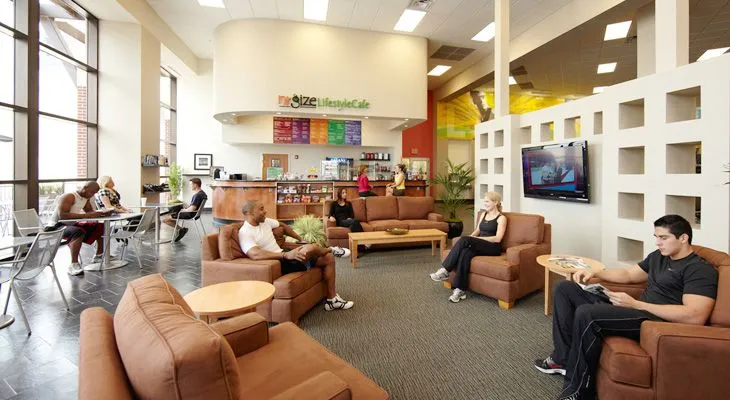
Photo: welcoming independent gym community lounge area members socializing, via i.pinimg.com
Walk into most big-box gyms in America and you'll notice the same thing: everyone's got headphones in, eyes down, moving efficiently from machine to machine. It's not unfriendly exactly — it's just... transactional. You're there to do a thing, and so is everyone else, and that's the whole deal.
Now walk into a gym that's actually functioning as a community hub. The vibe is completely different. People are lingering. Someone's asking the front desk person about their weekend. There's a cork board with local event flyers. Two members are arguing, affectionately, about whether the new playlist is better than last month's. You feel, weirdly, like you've walked into a neighborhood spot — which is exactly what it is.
The sociologist Ray Oldenburg called these places "third places" — the informal gathering spots that exist outside home (first place) and work (second place) where community actually gets built. Barbershops. Diners. Coffee shops. The corner bar. And increasingly, for a lot of Americans, the right kind of gym.
So what makes a gym a genuine third place rather than just a fitness facility with better lighting? Here's what we've found actually moves the needle.
1. Staff Who Know Your Name — and Mean It
This sounds basic. It isn't. In most commercial gym chains, front desk staff turnover is high, training is minimal, and the job is essentially badge-scanning. Members are account numbers. The interaction is functional at best.
In gyms that function as third places, staff are connective tissue. They remember that you had a job interview last Tuesday. They notice when you haven't been in for two weeks. They introduce members to each other when they think they'd get along. This isn't a customer service script — it's genuine community stewardship, and it requires hiring for personality and investing in retention.
The corporate chain model runs on efficiency. That's fine if you're selling fast food. It's a dealbreaker if you're trying to build belonging.
2. Programming That Has Nothing to Do With Working Out
Here's a counterintuitive truth: a gym becomes a third place when it stops being only about fitness.
The gyms doing this well are hosting movie nights, local author talks, charity drives, trivia nights, post-race brunches, and neighborhood cleanups. They're partnering with local restaurants for member events. They're running book clubs that happen to meet at the gym. None of this directly improves anyone's deadlift — and that's the point.
When a gym programs social experiences, it signals to members that the relationship isn't purely transactional. You're not just a body to be optimized. You're a person who might want to watch a documentary about ultramarathon runners with twenty of your neighbors.
Big chains can't do this authentically because they're not actually embedded in a neighborhood. They're a brand occupying a location. There's a difference.
3. Members Have a Real Voice
One of the most reliable markers of a genuine community space is whether the people who use it have any actual say in how it operates.
Some independent gyms have started doing things like member surveys that actually change equipment decisions, open-floor community meetings, member-led class proposals, and informal advisory groups. These aren't just PR gestures — they're structural acknowledgments that the gym belongs to the people in it, not just to whoever owns the building.
Compare that to a franchise location where every policy, playlist, and piece of equipment is handed down from a corporate office in another state. Members can complain all they want; nothing's changing. That dynamic doesn't build community. It builds resignation.
4. The Physical Space Is Designed for Lingering
Most commercial gyms are designed to maximize floor space for equipment. Seating is minimal. Common areas are awkward. There's nowhere to naturally congregate that doesn't feel like you're in someone's way.
Third-place gyms invest in the in-between spaces: a comfortable lounge area near the entrance, a good coffee setup, maybe a few tables where people can actually sit after class. Some have whiteboards where members post things — race results, new PRs, local happenings. Small design choices that say: you can stay a while.
It sounds like a small thing. It isn't. The physical environment sends constant signals about what kind of place this is and what kind of behavior is welcome. A gym with nowhere to sit is telling you to leave when you're done. A gym with a couch and decent espresso is telling you something else entirely.
5. The Culture Is Explicitly Inclusive — Not Just in the Marketing
Every gym website in America has a photo of a diverse group of smiling people. That's table stakes now and it means essentially nothing.
What actually makes a gym welcoming is the unwritten social contract among members — whether the regulars make room for newcomers, whether the vibe is competitive in a way that excludes or competitive in a way that lifts everyone up, whether different fitness levels and body types are visibly represented in how the space is run and who gets celebrated.
This is culture, and it's almost impossible to manufacture from the top down. It has to be modeled, protected, and occasionally enforced. Gyms that get this right are usually doing it intentionally — through how they handle conflict, who they hire as coaches, what they put on their walls, and what behavior they quietly but firmly don't tolerate.
The Bigger Picture
America has a loneliness problem. It has for a while. And while no gym is going to fix a structural social crisis, the right kind of fitness space can be a genuine antidote to isolation for the people lucky enough to find one.
The corporate chains aren't failing because they're bad at fitness. They're failing as community spaces because community was never the product. Efficiency was. Scale was. The third-place gym inverts that priority — it starts with belonging and builds the fitness experience around it.
That's a harder thing to run. It's also a much better place to spend your Tuesday morning.